How to Write a Goodbye Letter to Your Pet: Prompts and an Example
In this article
After a pet dies, many people find themselves with things they wanted to say and no one to say them to. Thank-yous. Apologies. Stories. "I miss you." A letter is one of the simplest and oldest ways to say them.
You do not need to be a writer. Nobody else has to read it. This guide offers a few ways to begin, a list of prompts, and an example you can borrow from or ignore completely.
Why writing helps
Grief tends to circle in the mind: the same memories, the same regrets, the same silent conversations. Writing slows the circling down and puts words on the page so they stop looping. Many people also find that it gives them a sense of closure that does not depend on anyone else.
A letter is not a cure, and it will not make the sadness vanish. But it can be a kind, private ritual.
Before you begin
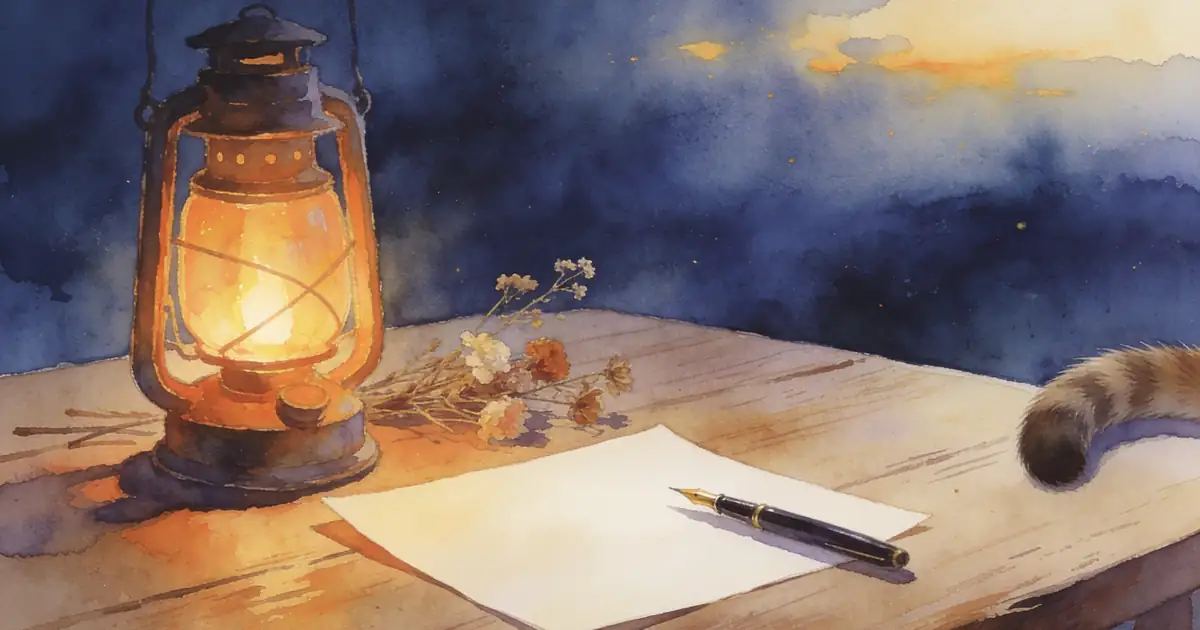
- Choose a quiet time. A few minutes with a cup of tea, or an evening with a candle.
- Have tissues and water. You may cry, which is fine.
- Decide how long. A letter can be three lines or three pages.
- Write by hand if you like. The pace of a pen can be calming. A phone or computer works too.
- Do not edit. This is not for grammar. If you stop and start, that is fine.
- Start with their name. "Dear Maple," is enough.
Prompts to get you started
Choose one or two, or use them all.
Gratitude - Thank you for... - The thing you taught me was... - You made my days better by...
Memories - My favorite memory of you is... - I will always remember the way you... - The funniest thing you ever did was... - I still smile when I think of...
What I wish I had said - I wish you had known... - I am sorry that... - I hope you knew...
The last days - In your last days, I remember... - I want you to know that I was with you in my heart when... - I hope you felt...
What I miss - What I miss most is... - The hardest part of the day is... - The house feels different because...
What I will carry - I will keep... - I promise to... - Because of you, I am...
What I want you to know now - Our home is... - The others are... - I am trying to...
A simple structure
If you like a form, try this four-part shape:
- Open with their name and a feeling. "Dear Bailey, it has been three weeks and the house is still too quiet."
- Say thank you. Name two or three specific things.
- Say what is hard. The regret, the missing, the question.
- Close with what you will carry forward. A promise, a memory, a blessing.
An example (original, to adapt)
Dear Pepper,
It has been two weeks, and I still look at the windowsill when I come into the kitchen. You were there every morning, watching the street like it was your own private television.
Thank you for the years you picked my lap over every other spot in the house. Thank you for the way you pushed your head against my hand when I was sad, as if you had decided I needed to be reminded that I was loved. Thank you for the terrible 4 a.m. concerts, which I would give almost anything to hear again.
I am sorry I was not home at the end. I have told myself a hundred times that you were not alone and that you knew you were loved. Most days I believe it.
I miss you. I miss the sound of your claws on the floor and the weight of you on the bed. The house is quieter, but you are all over it: in the hair on the couch, in the dent in the pillow, in every habit I still have of making room.
I will keep your collar on the shelf, and I will tell people about the cat who ran the house. Thank you for being mine.
With love, Sam
Your own will sound different, and it should. Use your words, your details and your pet's quirks.
If you cannot find the words
It is common to sit down and write nothing. Some gentler ways in:
- List what you will miss. A simple list works as well as a paragraph.
- Write one sentence a day. "Today I thought of you when..."
- Write to a friend about your pet. Then turn it into a letter.
- Speak it aloud, into a notes app, and transcribe later.
- Draw or doodle if words do not come.
If you are carrying guilt
A letter can be a place to put the "what ifs." Write them down, plainly. Then, below, write what you would say to a friend in your position. You might surprise yourself. Our article on guilt after pet euthanasia offers more ways to approach these feelings.
What to do with the letter
There is no rule. A few choices:
- Keep it. In a drawer, a box, a book or beside a photo.
- Read it aloud in a quiet moment, at a grave or a favorite spot.
- Bury it with your pet's grave or in a garden pot, if burying paper is appropriate for your site.
- Burn it safely in a bowl or fire-safe container outdoors, if that feels meaningful. Take care with fire, and follow local rules.
- Put it in a memory box with a collar, tag, photo or other keepsakes.
- Share it with a friend or family member, if you wish.
- Rewrite on an anniversary. Many people write a new letter each year. See the first anniversary of a pet's death.
With children
Children can write or draw a letter too. For younger ones, a drawing with a few words dictated to an adult is perfect. Let them decide what to include, and what to do with it. Our guide to explaining pet loss to a child has more ideas for helping children say goodbye.
A note on feelings
You may feel lighter afterward. You may feel more sad. You may feel nothing, and then cry later. All of those are normal. If writing brings up distress that feels overwhelming, take a break, talk to someone you trust, and consider reaching out to a counselor. If you ever feel hopeless or think about harming yourself, please contact a local emergency or crisis service; in the United States, call or text 988.
Other ways to remember
A letter is one small way to honor a bond. For more, see our pet memorial ideas at home, including low-cost and no-cost ones.
This article offers general information and comfort. It is not veterinary, medical or mental health advice. See our disclaimer.
Related reading
Memorials and keepsakes
21 Pet Memorial Ideas You Can Do at Home (Many Cost Almost Nothing)
Simple, heartfelt ways to remember a dog, cat or other pet at home, from a memory shelf and paw print keepsakes to planting a garden, writing a letter or holding a small ceremony.
Memorials and keepsakes
The First Anniversary of a Pet's Death: Gentle Ways to Mark the Day
The anniversary of a pet's death can bring grief back unexpectedly. Find gentle ideas for marking the day, what to expect emotionally, and ways to look after yourself.
Coping with grief
Feeling Guilty After Pet Euthanasia: Why It Happens and What Can Help
Many people feel guilt, doubt and second-guessing after choosing euthanasia for a pet. Understand why these feelings are so common and find gentle ways to carry them.